
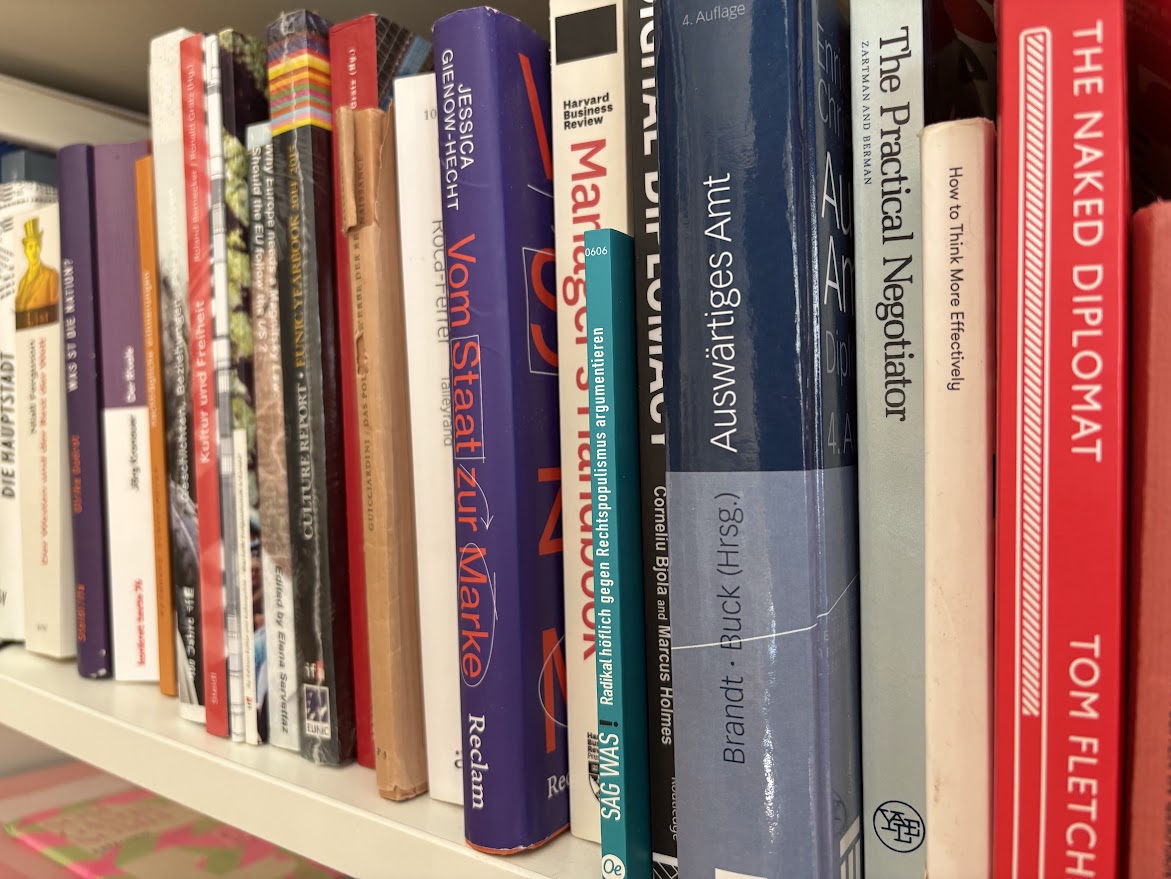
Rudin Harry R., ‘Diplomacy, Democracy, Security: Two Centuries in Contrast‘, Political Science Quarterly, 71/ 2, (June, 1956) pp. 161-181.
Here are my thoughts on the selected text:
Harry Rudin writes about political, economic and sociological shifts in the European society and about how its internal and international affairs have developed over the 19th century and the first half of the 20th century. He emphasises mainly on intra-European agreements, colonialism, trade, migrations and how rhetoric and fear can trigger certain political developments. Published in 1956 at Political Science Quarterly, he addresses an academic audience. It is not clear though, what sources Rudin uses, which makes his theoretical background somehow diffuse.
What is clear is that he gives a very benevolent interpretation of 19th century’s European politics. The author claims that the 19th century in Europe was marked by “rising standards of living while the population (…) more than doubled itself” (page 7) whereas the 20th century was marked by “brutality of men who had become unsecure” (page 8). International trade (= colonialism) is to him the key factor for European stability. And here’s the rationale’s major weak point:
If, as he says, colonialism played a key role in European 19th century politics and it was a mere mechanism to rise standards of living, then according to his logic, it was not brutal but peaceful. Rudin certainly admits, that in order to establish a balance of powers in Europe, other countries such as Morocco and Egypt were “victims sacrificed (…) on the altar of international conflicts” (page 22). But in the subsequent text he has a surprisingly favourable look on military expansion and exploitation of colonies for the sake of stability in Europe. Nothing is said about the widespread system of violence and abuses that made this stability possible. He simply ignores the suffering and death of hundreds of thousands of victims of colonization during the 19th century.[1]
Even though his arguments are biased by an outdated eurocentrism, we can say that paradoxically Rudin’s final conclusions still apply today. It’s in the last chapter, where a deeper understanding of the human condition gets reflected and where Rudin opens the framework of politics and diplomacy towards new insights: Rudin says that dynamics generated by fear, blind ideological devotion and economic instability do have its effects on splitting humanity into extremes and that these factors need to be taken in account in order to avoid new horrors of war.
What’s not said is whether in order to avoid all these destructive dynamics, international relations and diplomacy should be rather built on mutual respect than on oppression and violence.
[1] References
Wagner, K. A. (2016) ‘“Calculated Strike Terror”: The Amritsar Massacre and the Spectacle of Colonial Violence’, Past & Present, 233(1), p. 185. Available at: http://search.ebscohost.com/login.aspx?direct=true&db=edb&AN=119741590&site=eds-live (Accessed: 12 May 2019).
Leave a Reply